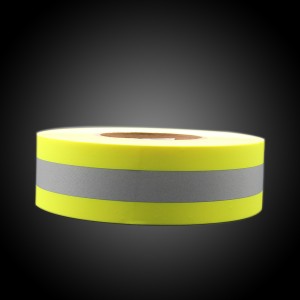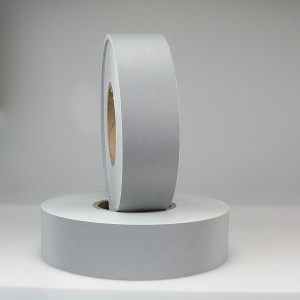
MHC-9671B Flame Retardant Fluorescent Yellow Photoluminescent Reflective HTV Tape


MHC-9671B Flame Retardant Fluorescent Photoluminescent Reflective Heat Transfer Vinyl Introduction

MHC-9671B Fluorescent Photoluminescent Reflective HTV Specification
We can customize the reflective HTV tape size, patterns, luminosity grades, and reflectivity levels to meet your specific requirements.
| Product code | MHC-9671B |
| Product type | Fluorescent Yellow Photoluminescent Reflective Heat Transfer Vinyl |
| Base material | PES or TPU hot melt adhesive |
| Flame Retardancy | EN ISO 14116 |
| Afterglow Intensity | ISO 17398 Class B: 10 min >70 mcd/m² Test Standard: D65 light source, 1000 lux, 5 min excitation |
| Reflectivity | EN ISO 20471 and ANSI/ISEA 107: ≥330 cd/(lx·m²) |
| Material Safety | OEKO-TEX 100 Standard |
| Wash Durability | 50 washes at 60°C (ISO 6330) and 25 dry clean cycles (ISO3175) |
| Width | 5 cm, customized width available |
Why Choose MHC-9671B Photoluminescent And Reflective HTV
OEKO-TEX Standard 100
We are the first Chinese manufacturer to pass the OEKO-TEX 100 standard for our glow-in-the-dark and reflective heat transfer vinyl and fabric.
Clean Finish After Heat Pressing
When heat-pressed onto garments, it delivers a clean and premium finish with no dark edges.
100% In-House Manufacturing & End-to-End Quality Control
As a leading manufacturer in the optical functional materials industry with 23 years of expertise, we produce not only the reflective heat transfer vinyl but also the strontium aluminate photoluminescent pigment in-house. This vertical integration allows us to strictly control quality from the photoluminescent luminosity to reflectivity. We back our performance with scientifically measured luminance data, not just glow-hour claims.
How to Use Photoluminescent Reflective HTV
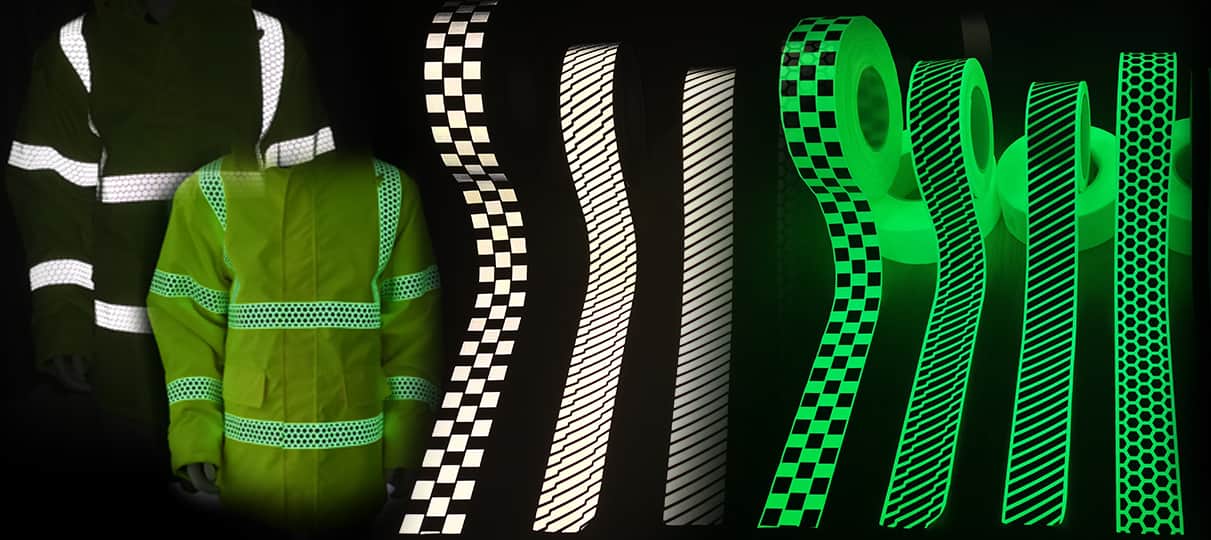
We recommend a pressing temperature of 135℃-155℃, a pressing time of 9~15 seconds, pressure of 5~6 kg. After the reflective HTV is completely cooled, peel off the protective film to finish the heat pressing process.
The conditions should be adjusted according to actual production. Always run a small test before committing to production.